
TL;DR: IMS (Intramuscular Stimulation) is a specific physiotherapist-and-physician form of dry needling developed in Vancouver. IMS, trigger-point dry needling and acupuncture all use the same style of thin needle, but they work from different assessment models — the terms are not interchangeable.
Direct answer: IMS and dry needling both use a thin, acupuncture-style needle to release tension held in tight muscles. IMS has its own clinical framework — developed by physician Dr. Chan Gunn at iSTOP (the Institute for the Study & Treatment of Pain), and practised primarily by physiotherapists and some physicians with post-graduate Gunn IMS certification. The Gunn IMS training is now run at the University of British Columbia since Dr. Gunn’s retirement. IMS targets nerve-driven (neuropathic) muscle pain. Dry needling is the broader umbrella term for inserting a needle with therapeutic intent without injecting any substance.
What is dry needling?
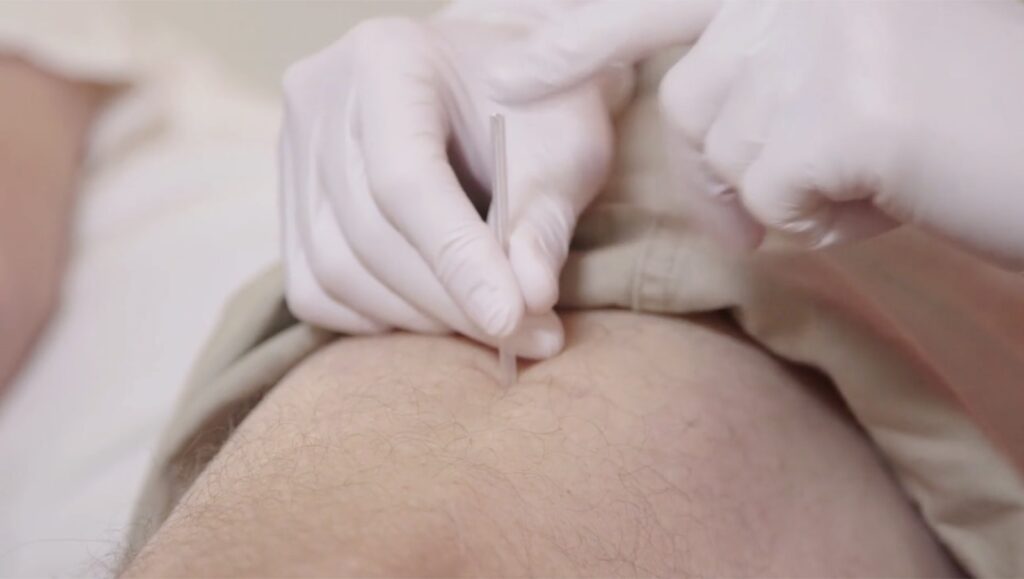
A physiotherapist inserts a fine filament needle into a trigger point — a tight, irritable band of muscle — to release tension and ease pain. The needle carries no medication, which is where “dry” comes from. The insertion and movement of the needle within the muscle often provokes a contraction or brief twitch, which triggers a reflex loop from your nervous system that inhibits the bracing muscle tone.
“Dry needling” is really a family of techniques rather than one method. Trigger-point dry needling, functional dry needling, and IMS all use the same kind of needle. What sets them apart is the reasoning behind where the needles go, and what the practitioner does with the needle.
What is IMS specifically?
IMS — Intramuscular Stimulation — was developed by Dr. Chan Gunn, a Vancouver-based physician who later passed on his body of work to the University of British Columbia. It has a genuine Vancouver origin story, which is part of why you see it practised so widely across BC — I wrote about how needling is integrated into physiotherapy practice in more depth a few years ago.
There is an art and a science to practising IMS well. The practitioner needs to be able to read the tolerance of the patient and appreciate how sensitive their nervous system is. Some patients may tolerate fifteen to twenty needle points while others may be fine with four. An experienced IMS physiotherapist looks at the body as a series of muscular tugs-of-war and treats the body as a whole, instead of simply hunting for painful trigger points.
Training matters here. To practise IMS in BC, a clinician completes formal post-graduate training through the iSTOP (Institute for the Study and Treatment of Pain) program or an equivalent. It is not a weekend skill anyone can pick up.
So are they the same thing?
They share the tool. The thinking and the training behind them don’t match.
Dry needling is the broad category. IMS is one specific, protocol-driven approach inside it, with its own assessment framework, its own rationale for needle placement, and its own training pathway.
IMS is a tool that physiotherapists integrate into their tool belts alongside posture and movement training, breath work, and strength and stretching exercises — it is one part of a broader physiotherapy plan, not a standalone treatment. IMS is the most powerful tool to first calm down a reactive nervous system, and it opens a window to teach a client how to move and feel better.
IMS vs dry needling vs acupuncture: a side-by-side comparison
| IMS (Intramuscular Stimulation) | Trigger-point dry needling | Acupuncture | |
|---|---|---|---|
| Assessment model | Western neuroanatomy — looks for a nerve root driving the muscle | Western musculoskeletal — locates the tight, irritable band | Traditional Chinese Medicine meridian theory |
| Where the needle goes | The shortened muscle near its motor point, and the paraspinal muscles at the relevant spinal segment | Into the local trigger point itself | Points selected from meridian mapping |
| What it targets | Nerve-driven (neuropathic) muscle pain | Local muscular trigger points | Varies by TCM diagnosis |
| Who practises it in BC | Registered physiotherapists and physicians with post-graduate Gunn IMS certification | Physiotherapists with dry needling training | Registered acupuncturists |
| Needle used | The same thin, filament acupuncture-style needle in all three — no medication is injected | ||
Who can perform IMS in Vancouver?
In BC, IMS is practised by registered physiotherapists and physicians who hold post-graduate Gunn IMS certification. It sits outside the scope of massage therapy, chiropractic, and personal training. Acupuncturists also use needles, but they work from a completely different diagnostic model — the needle might look identical, but the reasoning behind it is not.
That distinction matters when you’re deciding where to book. If a clinic advertises “dry needling” without saying which approach it means, it’s fair to ask the practitioner what method they use and what training they hold.
At Envision Physiotherapy’s South Granville and False Creek locations, the physiotherapists listed on our IMS and dry needling service page have completed post-graduate IMS training, and you can book with any of them directly through JaneApp.
Brent Stevenson, Harry Toor and Tracy Barber all learned IMS directly from Dr. Gunn at iSTOP, and have served as mentors to Erin, Frances, Marcus and Taylor. Marcus and Frances were certified by Sean Campbell at Foundations Health Education, where both Harry and Tracy help students as teaching assistants. Erin and Marcus are both certified in dry needling courses and have worked closely with Brent Stevenson in the clinic and on his online mentorship IMS course.
Does IMS hurt?
The honest answer: more than acupuncture, less than most people brace for.
IMS feels like a crampy, achy, squeezy, pressure feeling for about five to ten seconds while the needle is in, and then it is quickly over. Muscles that twitched strongly can linger, feeling bruised or sore like a hard workout, for anywhere from an hour up to two days. The most common experience is to feel a bit sore that day and little to nothing the following day. Heat and gentle movement calm most of the lingering soreness.
What conditions respond best to IMS?
IMS tends to do its best work on chronic, neuropathic-pattern pain — the cases that haven’t budged with standard physiotherapy, massage, or time. Presentations it is commonly used for include:
- Long-standing neck and upper-back tightness with referred or nerve-like symptoms
- Tension-type headaches linked to cervical or upper-trapezius trigger points
- Tendinopathies — Achilles, rotator cuff, lateral elbow — where the shortened muscle is pulling on the tendon
- Sciatica and gluteal pain with a nerve-root component
- Chronic low-back pain that hasn’t responded to manual therapy on its own
I use IMS to treat a lot of the Vancouver Lawn Tennis Club tennis players with rotator cuff impingements, tennis elbow and calf strains at our South Granville office. At False Creek we see a lot of runners along the seawall suffering from heel pain, Achilles issues, and tight IT bands that really benefit from IMS — often paired with a running assessment to find the load pattern that caused them — often alongside the sports physiotherapy work, or a bike fit where cycling load is part of the picture.
It isn’t the right tool for everything. Acute injuries, inflammatory conditions, and patients on blood thinners need a different plan, and a proper physiotherapy assessment always comes first — which is why every IMS and dry needling appointment at Envision starts with one.
How many sessions does IMS typically take?
There’s no fixed number. The Gunn model holds that more chronic, more widespread neuropathic involvement takes longer to resolve than a recent or focal problem — so the timeline really does depend on what you walk in with.
Typically I will see clients once per week, three to four times, then start spacing the treatments out to every two weeks and then every four weeks as needed. People commonly have six to eight sessions of IMS and then may move to coming in once every four to six weeks for a tune-up.
Frequently Asked Questions
Is IMS the same as acupuncture?
No. IMS uses acupuncture needles, but the assessment and placement rationale are entirely different. IMS works from Western neuroanatomy and musculoskeletal diagnosis; acupuncture works from Traditional Chinese Medicine meridian theory. Sharing a tool doesn’t make them the same treatment.
Can anyone do IMS, or does it have to be a physiotherapist?
In BC, IMS as defined by the Gunn framework is practised by physiotherapists and physicians with post-graduate iSTOP or equivalent certification. Other practitioners may offer general dry needling, but “IMS” specifically refers to the Gunn approach and its training pathway.
Does extended health insurance cover IMS in Vancouver?
IMS is simply part of physiotherapy and is billed as such. There is no extra charge at Envision for the physiotherapist using IMS, so it falls under your physiotherapy benefit rather than a separate needling line. Check your plan’s physiotherapy coverage — most group plans in BC cover a portion. If your pain follows a car accident, ICBC coverage works differently and is worth reading before you book.
What should I do to prepare for an IMS session?
You don’t need to prepare. Just don’t plan a hard workout or vigorous exercise after your treatment session. Light movement is fine, but don’t plan to lift heavy, sprint or jump on the day of IMS. It’s also best not to stack multiple treatments on the same day. Wear loose clothing that gives the physiotherapist easy access to the area being treated. You do not need a doctor’s note to book — a referral is not required to see a physiotherapist in BC.
How is IMS different from trigger-point dry needling?
Trigger-point dry needling targets the local knot in the muscle. IMS pushes the assessment upstream — to the nerve root supplying that muscle and to the paraspinal muscles along the relevant spinal segment. Trigger-point needling tends to chase pain points on a person, while IMS does a better job of asking why that point is painful and addressing the broader area.
About the author
Brent Stevenson has been a physiotherapist in Vancouver for twenty-three years, since 2003. He is the founder and co-owner of Envision Physiotherapy. He learned the skill of IMS directly from Dr. Chan Gunn in 2008 and has developed his own online video-based mentorship course to help improve physiotherapists’ handling skills and clinical decision-making with IMS dry needling.
Living with pain that hasn’t shifted with the usual treatment?
Book an assessment at our South Granville (604-737-7309) or False Creek / Olympic Village (604-876-2344) clinic and we’ll tell you honestly whether IMS is the right fit for what you’re dealing with. Contact us to get started.
This article is written for educational purposes and does not replace individual medical advice. If you have a specific injury, see a physiotherapist or physician for assessment.