
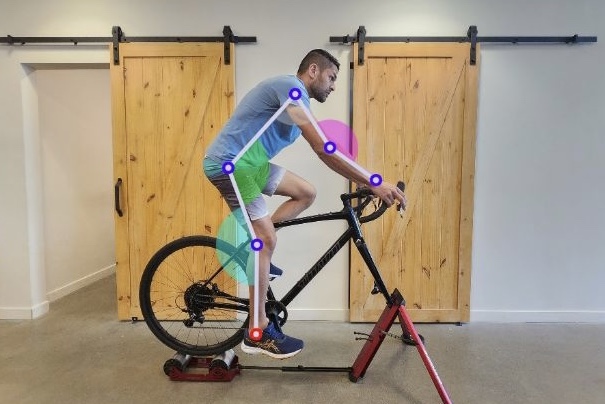
TL;DR: A poor bike fit is one of the most common and most preventable causes of cycling knee and back pain. A physio-led fit goes after the biomechanical cause, not just the sore spot.
Direct answer: A physio-led bike fit corrects saddle height, reach, and cleat alignment to take stress off the knees, lower back, and hips. In addition to looking at your available biomechanics, we also take into account old and current injuries. Most cycling pain is position-related rather than injury-related, and sorting the fit out before pain turns into injury is faster and cheaper than treating the injury later.
Why does cycling cause knee pain?
The knee takes the most overuse injuries of any joint in cycling, and position is usually why. Drop the saddle too low and the knee stays bent and compressed through the whole pedal stroke — the kneecap (the patellofemoral joint) wears the load. Set it too high and the leg over-extends at the bottom of the stroke, which pulls on the structures behind the knee.
Cleat alignment also has an impact. Depending on your own structure — some people are more internally rotated, some more externally — your ideal alignment may differ from someone else’s. Finding your ideal position can minimise the twisting forces you feel through each pedal stroke.
What does a physiotherapist look for that a bike shop fit doesn’t?
A bike shop fit is built around power output and comfort for the average rider. Useful, but it isn’t a clinical assessment.
I start with the person, not the bike. Before a rider gets on the trainer, here’s what I’m checking:
- Hip and ankle mobility — limited hip flexion changes how the pelvis loads at the top of the stroke; tight ankles change heel drop and how the foot tracks.
- Cervical, thoracic and lumbar spine mobility — a rider with a sensitive disc needs a different reach and stack than someone with a healthy back, and what your upper back and neck can do decides how aggressive a position you can actually hold.
- Lower limb alignment — watching the knee track through a single-leg squat shows the valgus or varus tendency that the cleats and saddle have to work around.
- Injury history — old injuries and dysfunction can affect your setup, as can new injuries or current problem areas you’ve been dealing with.
What I’m after is a position the rider can actually hold given their body — not a textbook-optimal position. If you want the full screen, our physiotherapy bike fitting service runs out of our False Creek clinic.
My back hurts on the bike — is that a fit issue or something else?
Often it’s both, and the order you sort it in matters.
Low back pain on a bike can trace back to many different things: a reach that’s too long, so the rider lengthens the lower back to get to the bars; a saddle that’s too high, which can tilt the pelvis; or an intrinsic issue within the rider, such as stiffness, weakness, or an injury limiting their safe positioning. If the reach is too short, you crunch up and ride more flexed instead.
We always look at the patient first. Bike fitting can involve dealing with the patient’s function and capabilities first, and then making the bike setup optimal for that person.
While there are some highly skilled bike fitters out there, a physio-led bike fit looks at the rider with an understanding of injury and biomechanics. We can help find the balance between what can be changed within the body and what the optimal bike fit will be.
Can a bike fit help if I already have an injury?
Yes. A physiotherapist can do a proper assessment of your injury and determine what can be fixed and what should be worked around. For example, if you have good thoracic extension, you can tolerate a more aerodynamic — or aggressive — racing position on the bike. If you don’t have that extension, working on improving it can be helpful. However, how much you can improve it will vary. Sometimes the fix is exercise to improve your body’s ability to achieve these positions, while also opting for a slightly less aggressive position to avoid overloading your neck and upper back.
Whatever the adjustment, it doesn’t work on its own. The fit removes the cause of the loading; the rehab rebuilds the capacity to handle that load. You need both.
If you also run, the patterns tend to feed each other. A running assessment looks at the same hip, knee, and foot mechanics from a different angle, and it can surface asymmetries that show up in both sports. Both sit under our sports physiotherapy service, and where a stubborn muscular restriction is part of the picture, IMS and dry needling can be part of the plan (here is how IMS and dry needling differ).
Frequently Asked Questions
How long does a physiotherapy bike fit take?
A full assessment — movement screen, on-bike video, and position adjustments — usually runs 90 minutes. Follow-ups are shorter and focus on refining the position as you adapt to it.
Do I need to bring my own bike?
Yes. We do the fit on your actual bike, on a trainer. That gives us real numbers off your real position instead of an estimate from a generic sizing rig.
Can a bike fit help with numbness in my hands?
Hand numbness usually points to reach and bar setup — both position and drop. We look at your saddle position relative to your centre of mass, and at your handlebar setup: roll, hood position, and stem length. Both are well within what a physio bike fit covers.
Is a bike fit just for competitive cyclists?
No. Recreational riders rack up plenty of hours, and they’re just as prone to injury — sometimes more. Regardless of level, we’re dealing with the interface of a capable human and a bike. Some riders have a greater capacity for loading, but whether you’re a commuter, a gravel rider, or anyone logging kilometres, finding the right fit can be helpful.
Does extended health cover a bike fit?
Most extended health plans in B.C. cover physiotherapy billed as an assessment, and the bike fit is truly a physiotherapy consultation — biomechanics and injury history combined with an ergonomic assessment. Check your own plan’s annual physiotherapy maximum, as coverage varies between plans.
About the author
Harry Toor is a registered physiotherapist and co-owner of Envision Physiotherapy in Vancouver. He spent three years as the therapist for the Canadian Men’s Ski Team and was part of the medical team for the 2006 and 2010 Winter Olympics. He is an instructor for Sport Physiotherapy Canada (including First-Responder for Sport) and the Canadian Red Cross, an Adjunct Professor in the Gross Anatomy Lab at UBC’s Physiotherapy Masters Program, and an IMS instructor for Foundations Health Education. His treatment combines manual therapy, IMS and exercise.
Knee or back pain on the bike?
Bike fitting runs out of our False Creek / Olympic Village clinic (604-876-2344). Bring your own bike — we fit you on the bike you actually ride. Not sure whether it’s a fit problem or an injury? Contact us and we’ll help you work out which.
This article is written for educational purposes and does not replace individual medical advice. If you have a specific injury, see a physiotherapist or physician for assessment.